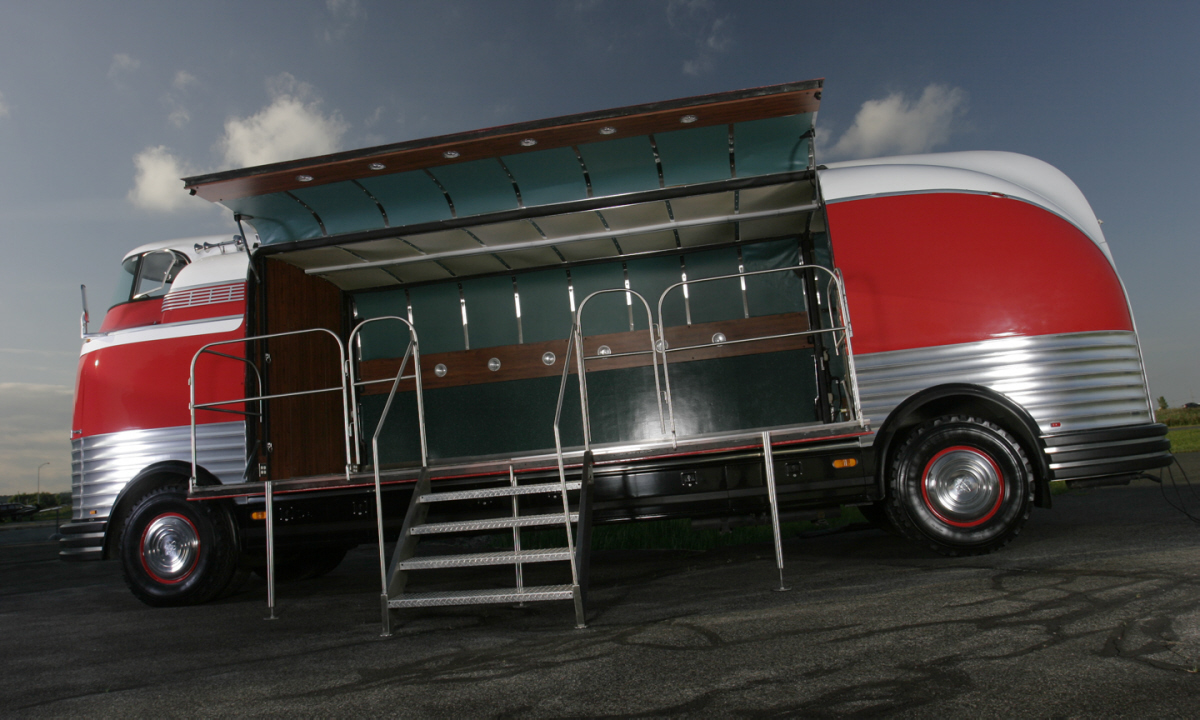
Honestly, if you saw a 13-ton, 33-foot-long red behemoth rolling toward your town in 1953, you’d probably think aliens had finally decided to visit the Midwest. That was the whole point of the GM Futurliner interior and its flashy Art Deco shell. It was a rolling promise of a better tomorrow. But once the side doors clammed shut and the crowds went home, what was it actually like inside that "cockpit" in the sky?
Most people assume these things were like luxury motorhomes or advanced command centers. They weren't. Not even close.
Climbing into the Sky: The Cockpit Reality
To get into the driver's seat, you didn't just open a door and hop in. You had to open a door at the front right and climb a narrow, steep set of stairs. Imagine doing that in a 1950s suit while carrying a briefcase.
Once you reached the top, you were sitting with your head roughly 10 feet above the pavement. It’s a "commanding" view, sure, but it’s also terrifying. You're basically perched in a glass bubble. Early models had a full plexiglass dome that looked like something out of The Jetsons.
The problem? Physics.
That glass dome acted like a giant greenhouse. Drivers were literally roasting alive in the summer sun. By the 1953 "Parade of Progress" refresh, GM had to swap the bubble for a more traditional wrap-around windshield and a metal roof. They also finally added Frigidaire air conditioning, which was a massive relief for the guys tasked with driving these 30,000-pound monsters across the country.
The Seating Arrangement
Inside that tiny cabin, space was at a premium. The driver sat front and center. It was a single-seat setup, giving the pilot total focus on the road (and the massive steering wheel). Directly behind the driver were two small "jump seats."
These weren't for luxury. They were for "paraders"—the young college graduates GM hired to run the show. Usually, while one guy drove, the others would just hang out or try to navigate. It was cramped. It was noisy. And if you were sitting in those back seats, you mostly just saw the back of the driver's head and a lot of lime and hunter green vinyl.
That Massive Middle Section: It’s Not a Living Room
Here is the big misconception: the GM Futurliner interior was not a cabin for people.
Aside from the three seats up top and the mechanical space for the engine, the rest of the 33-foot body was almost entirely hollow or filled with heavy machinery. This wasn't a bus. It was a "display vehicle."
When the Futurliner arrived at a site, the 16-foot side panels would fold out like giant wings. One side formed a stage, the other a marquee. Inside that cavernous middle area was the exhibit.
- Jet Engines: A full-size cutaway of an Allison jet engine.
- The "Miracles of Heat and Cold": A demonstration of how microwaves (brand new tech!) could cook food.
- City Planning: Dioramas showing how highways would change American life.
There were no beds. No kitchenettes. Just wires, gears, and the massive 200-kW Detroit Diesel generators needed to power the lighting towers that rose seven feet out of the roof.
Driving the Beast from Within
If you look at a restored GM Futurliner interior today, like the famous No. 10 at NATMUS, you'll see a dashboard that looks more like a 1940s bomber than a truck.
It was a nightmare to drive.
The steering wheel was huge because the truck had dual front wheels—literally two tires on each side of the front axle. Even with the power-assist steering added later, it had zero feedback. You'd turn the wheel and just sort of hope the 15 tons of metal followed your suggestion.
The gear setup was even weirder. After the 1953 update, it had a four-speed Hydra-Matic automatic transmission. But that was paired with two additional manual reduction units. Drivers had to manage a complex dance of levers to get the thing up to its blistering top speed of about 40 mph. Going downhill, you might hit 50, but then you had to worry about the brakes. The brakes were notoriously bad—so bad that GM told the drivers to stay 300 feet apart at all times so they wouldn't rear-end each other.
Why the Interior Style Mattered
Even though it was a "work" vehicle, GM didn't skimp on the aesthetics. Harley Earl, the legendary head of GM design, made sure the interior materials felt premium for the time.
- Upholstery: Two-tone green leatherette (vinyl) that was durable but looked sleek.
- Glass: Green-tinted "E-Z Eye" glass, which was the largest installation of its kind at the time.
- The "Autronic Eye": A small sensor on the dash that would automatically dim the high beams when it saw oncoming traffic.
It was a weird mix of high-tech luxury and industrial crampedness. You had the world's most advanced headlights and AC, but you were sitting on a tiny stool in a metal box that smelled like diesel and hot vinyl.
What Happened to the Interiors?
When the Parade of Progress ended in 1956—mostly because television meant people didn't need to go to a town square to see "the future"—the Futurliners were sold off.
Some were stripped. One became a "Cathedral Cruiser" for a traveling preacher. Another was turned into a motorhome by a guy named Bob Valdez (Futurliner #9), who actually built a bar and living quarters inside that massive display area. That's probably where the "motorhome" myth comes from; people see the custom ones and think they were all like that.
But the originals? They were stages. They were tools. They were 13-ton billboards.
Actionable Insights for Enthusiasts
If you're looking to see a real GM Futurliner interior without a time machine, your options are limited but high-quality.
- Visit NATMUS: Futurliner No. 10 is the gold standard for restoration. It's located in Auburn, Indiana. You can actually see the cockpit stairs and the green vinyl seats.
- Check the VIN: If you ever find one in a barn (unlikely, but hey), look for the plate near the driver's seat. Only 12 were made, and only 9 are known to still exist.
- Study the Doors: If you see windows on the side of a "Futurliner," it’s a custom job. The originals were solid metal "clamshell" doors with no side windows in the cargo area.
The Futurliner remains a masterclass in American optimism. It shows a time when we weren't just building cars; we were building a vision of the world where even a display truck deserved a cockpit that felt like a spaceship.