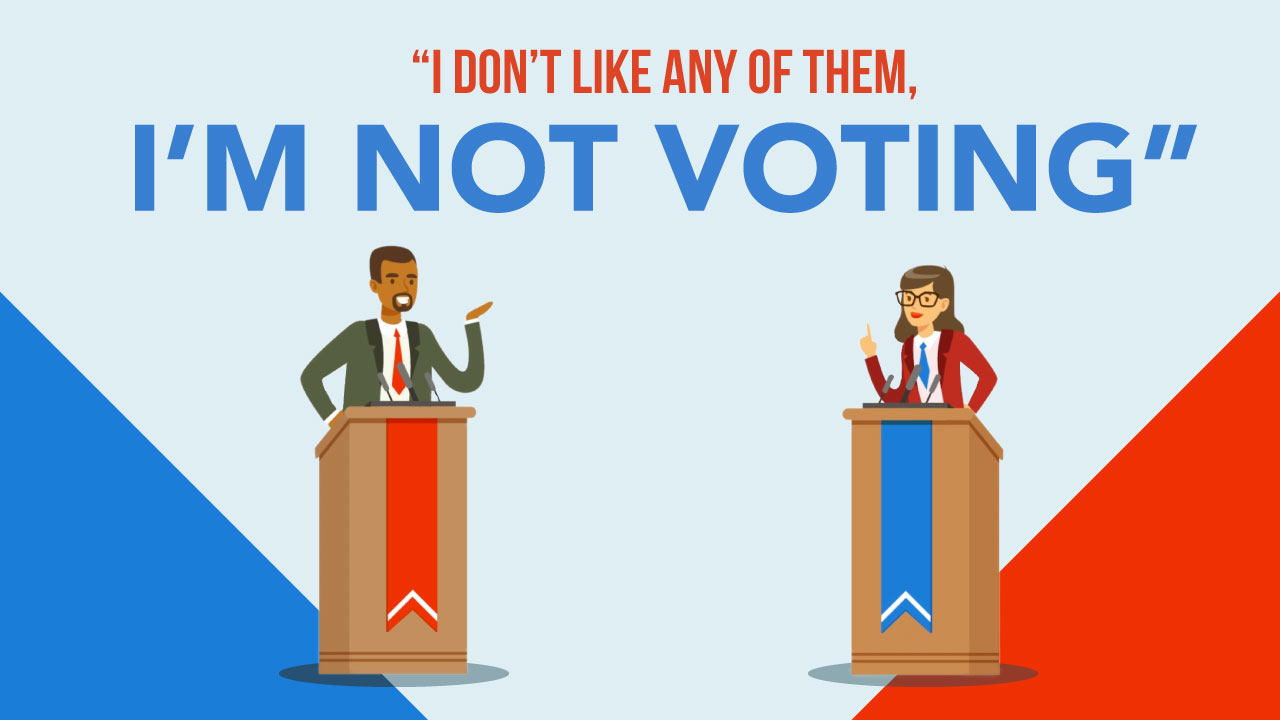
Staring at a ballot can feel a lot like looking at a restaurant menu where the only two options are "expired milk" and "stale crackers." You’re hungry for change, but neither choice sits right. It’s a 2026 reality for many. You show up, the curtain closes, and suddenly the "lesser of two evils" argument starts playing like a broken record in your head.
But here’s the thing. You aren’t actually stuck.
A lot of folks think the only way to "protest" is to stay home on the couch. Honestly, that’s exactly what the big campaigns want you to do because it makes their math easier. If you want to know how to vote if you don't like either candidate, you have to realize that the ballot isn't just a two-door hallway. It’s a much bigger room.
The "Blank Space" Strategy: Understanding the Undervote
Most people don't realize you can just... not. If you leave the top of the ticket blank—the race for Governor or Senator or whatever big office is stressing you out—your ballot still counts. This is called an "undervote." It’s a very specific, recorded statistic.
Election officials track how many people showed up to vote for a local school board but skipped the main event.
When a "major" candidate wins with 51% of the vote, but 10% of the total voters left that section blank, it sends a loud, data-driven message. It says: "I was here, I care about my community, but you specifically didn't earn my trust." According to data from organizations like Ballotpedia, an undervote doesn't disqualify the rest of your ballot. You can still vote for that local tax levy or the judge you actually like.
However, be careful with ballot measures. In some states—like Illinois or Hawaii—constitutional amendments require a certain percentage of total voters to pass. In those rare cases, leaving a bubble blank is legally identical to a "No" vote.
The Third-Party Reality Check
Third-party candidates are often treated like ghosts—everyone talks about them, but nobody expects to see them in the winner’s circle. In the 2026 midterms, we’re seeing a rise in Libertarian, Green, and Forward Party candidates across the country.
Voting for a third party isn't "throwing your vote away." It’s more like a long-term investment.
If a third party hits 5% of the national vote, they often qualify for federal funding in the next cycle. That’s a massive deal. It gives them the cash to actually compete next time. If you’re voting for a candidate from a smaller party, you’re basically saying you want more chairs at the table in 2028 and beyond. Experts like Dr. Tammy Greer have noted that third parties often force the two main parties to adopt popular "fringe" ideas just to win those voters back.
Write-In Rules: Why Mickey Mouse Won't Help
We’ve all heard the stories of people writing in "Batman" or their dog. Funny? Kinda. Effective? Not really.
In most states, a write-in vote only counts if the person has filed "intent" paperwork. For example, in California and Texas, if you write in a name that isn't on the official "certified write-in" list, the machine just ignores it. It’s basically the same as leaving it blank, but with more effort.
If you truly want your write-in to count, check your Secretary of State’s website about 48 hours before you head to the polls. There’s usually a PDF list of "certified write-in candidates" who are actually running but didn't get enough signatures for the main ballot.
Is Ranked Choice Voting Available for You?
Depending on where you live, the "lesser of two evils" problem might already be solved. In 2026, more jurisdictions are using Ranked Choice Voting (RCV).
With RCV, you don't just pick one. You rank them: 1st choice, 2nd choice, 3rd choice. If your #1 pick is a long shot and they lose, your vote isn't dead. It automatically moves to your #2 pick. It’s like a built-in safety net. Places like Alaska, Maine, and dozens of cities (from New York to Minneapolis) use this. If you have it on your ballot, use it. It’s the only way to support a "fringe" candidate you love without accidentally helping the candidate you hate.
The Down-Ballot Power Play
Let's get real for a second. The person running for President or Governor has a huge impact, sure. But the person running for City Council or County Clerk probably affects your daily life more.
If you hate the top of the ticket, ignore them. Seriously. Scroll down.
- School Boards: They decide what your kids learn.
- Sheriffs and DAs: They decide how the law is actually enforced on your street.
- Coroners and Auditors: They manage the money and the "boring" stuff that keeps a city from collapsing.
A common mistake is "straight-ticket" voting, where you just hit one button for a party. If you don't like the candidate, don't do that. Pick and choose. Be a "split-ticket" voter. It forces the parties to realize they can't just rely on a brand name to get your support.
Why Staying Home Is the Worst Option
When you don't show up, you are invisible. Politicians look at "Likely Voter" models. If you don't vote, you aren't a "Likely Voter." This means they don't care about your opinions, your problems, or your demographic.
Casting a "None of the Above" vote (even if it's just by leaving it blank) keeps you in the system. It keeps you as a person they need to win over.
What You Should Do Next:
- Check your ballot before you go. Use a tool like the League of Women Voters’ Vote411 or Ballotpedia. Read the names you don't recognize.
- Look for "certified" write-ins. If there’s an Independent candidate who actually filed paperwork, your vote for them will be tallied as a real vote for a real person.
- Focus on the measures. Even if you hate every human on the ballot, there are likely tax, school, or legal measures that require a "Yes" or "No." Those are often decided by just a few dozen votes.
- Confirm your state's "Blank Vote" laws. If you’re in a state like Ohio or Florida, confirm whether leaving a race blank affects the majority requirements for other measures on the same page.
Voting isn't a marriage proposal; it's a chess move. Sometimes you aren't playing to win the whole game in one turn; you're just trying to put your pieces in a better position for the next one.