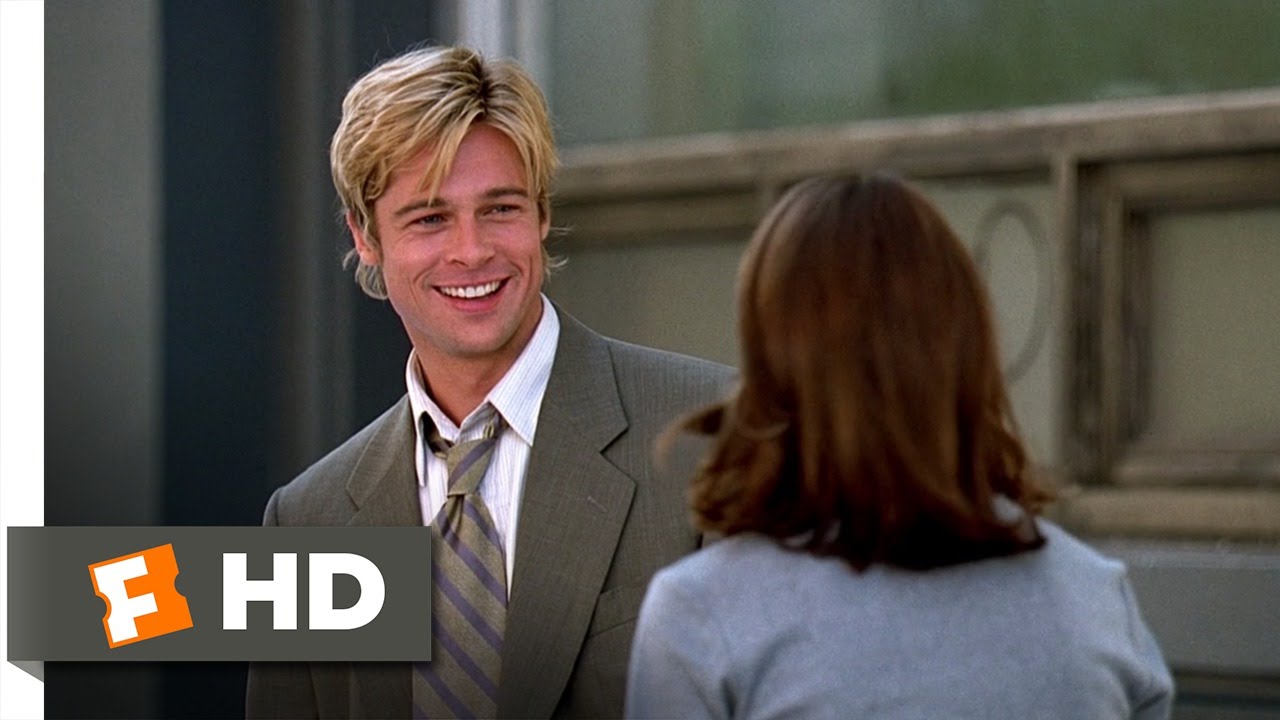
If you’ve spent any time on the "weird" side of movie Twitter or TikTok lately, you’ve probably seen a clip that looks like a fever dream. Brad Pitt, looking like a 90s bleach-blonde Greek god, leans over a hospital bed and begins speaking in thick, rhythmic Jamaican Patois. For some, it’s the pinnacle of "so bad it’s good" cinema. For others, the Meet Joe Black Jamaican scene is one of the most spiritually resonant moments in a film that otherwise feels like a three-hour-long perfume commercial.
Most people remember Meet Joe Black for the peanut butter or that infamous, physics-defying car accident at the start. But the hospital sequence with the elderly Jamaican woman is where the movie actually stops being a romance and starts being a film about Death.
The Woman Who Saw Through the Disguise
Joe Black spends most of the movie blending in—well, as much as a guy who looks like Brad Pitt can. He's the "mysterious stranger" following Anthony Hopkins around. But the moment he steps into that hospital ward, the game changes. He meets Easter, played by the legendary Jamaican actress Lois Kelly Miller.
Unlike the billionaire moguls and socialites Joe has been hanging out with, Easter doesn't see a handsome young man in a suit. She sees exactly what he is. She clocks him immediately as a "Duppy"—a spirit—or something linked to "Obeah."
Honestly, the chemistry here is better than the lead romance. While Susan (Claire Forlani) is falling for Joe's vacant stares, Easter is terrified of him. She knows he’s the "bus driver" to the next place. This is the first time in the movie Joe has to drop the act. He can’t pretend to be a clueless intern or a curious tourist. He has to be Death.
Let’s Talk About That Accent
Okay, we have to address the elephant in the room: Brad Pitt’s Patois.
It is... a choice. If you watch it today, it feels jarring. You’ve got this Hollywood A-lister saying things like "Evera ting gon' be irey" and calling a woman "sistah" in a voice that sounds like he’s been listening to Bob Marley on a loop for 48 hours.
Surprisingly, it wasn't just a random improvisation. Pitt was actually coached by Lois Kelly Miller herself. Miller was a titan of Jamaican theater, a woman who lived to be 102 and was a household name back home. She wasn't just an extra; she was a pro who held the screen against a megastar.
Some linguists say Pitt’s cadence is actually decent, even if the "white guy doing a Caribbean accent" trope hasn't aged particularly well. But if you look past the potential cringe, the narrative reason for the accent is pretty cool. Joe isn't "doing an impression." As Death, he speaks every language. He’s communicating with Easter in the "tongue of her heart" to comfort her. It’s a moment of empathy from a character who is supposed to be cold and final.
Obeah, Duppies, and the "Next Place"
The dialogue in this scene is packed with Jamaican folklore that usually goes over the heads of casual viewers. When Easter accuses him of being Obeah, she’s talking about a system of spiritual healing and sorcery with West African roots.
In the Caribbean context, Obeah can be used for good or evil. Easter is convinced Joe is a malevolent force.
- Duppy: A ghost or spirit, often seen as mischievous or dangerous.
- Jumbie: Another term for a spirit or demon.
- Irey: Derived from "ivie" or "alright/fine."
Joe responds by saying, "Obeah evil. I not evil." He explains he's just on "holiday." It’s a rare moment where we get a peek at the mechanics of the afterlife in this movie’s universe. He’s not a monster; he’s a guide. He’s the one who eventually takes away her "pain tru an' tru."
Why the Scene Works (Even if it’s Weird)
The Meet Joe Black Jamaican scene serves a massive purpose for Joe’s character arc. Before this, Joe is basically a child in a man's body. He’s discovering the joy of cold noodles and the tingle of a first kiss. He’s selfish. He wants to stay on Earth because it’s fun.
Easter reminds him that for some people, his arrival isn't a tragedy—it's a release. She is in agonizing pain. She begs him to take her to the "next place." This is the first time Joe realizes that his "job" has a compassionate side. When he eventually touches her and eases her transition, it’s the most "human" thing he does in the entire movie.
What people get wrong about this scene:
- It wasn't meant to be funny. While it’s a meme now, the intended tone was deeply somber and mystical.
- It isn't a "magic negro" trope. While that’s a valid criticism of many 90s films, Lois Kelly Miller’s performance is actually quite confrontational and grounded. She’s the one in control of the conversation, not the "wise helper."
- Joe doesn't "cure" her. People often think he heals her. He doesn't. He manages her pain and essentially tells her that her time is coming soon, providing her with the peace of certainty.
How to Re-watch it Today
If you want to appreciate the scene without the 2026 "cringe" filter, try to focus on Lois Kelly Miller. Her expressions—the way her eyes widen when she realizes who is standing in front of her—are incredible. She brings a weight to the film that the $100 million budget couldn't buy.
Sorta makes you wonder what the movie would have been like if it spent more time in that hospital and less time at that over-the-top birthday party, doesn't it?
Your Next Steps for a Deep Dive
- Watch the raw footage: Look up the unedited hospital sequence on YouTube to hear the rhythm of the Patois without the soundtrack swelling.
- Research Lois Kelly Miller: She was an absolute icon in the Little Theatre Movement in Jamaica. Learning about her 102-year life makes her performance even more poignant.
- Compare the source material: Meet Joe Black is a remake of the 1934 film Death Takes a Holiday. Check out the older version to see how the "Death meets the common people" theme was handled without the Caribbean influence.
The scene remains a fascinating time capsule of 90s filmmaking—bold, a little bit awkward, but undeniably trying to say something big about how we face the end.