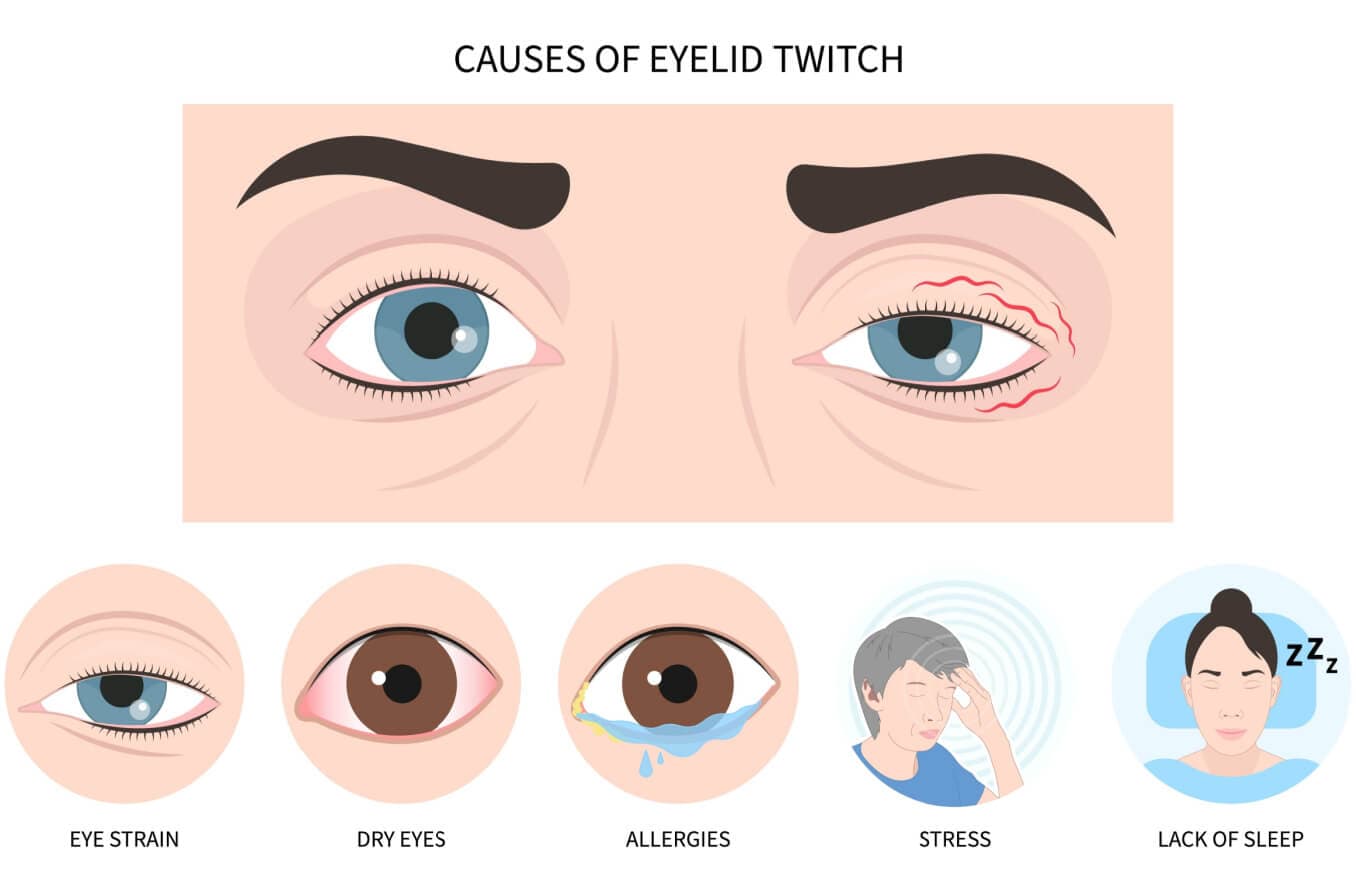
It starts as a tiny, rhythmic tug. You’re sitting at your desk, maybe halfway through your third coffee, and suddenly your lower eyelid decides to go into business for itself. You blink. You rub it. You stare in the mirror, waiting for it to happen again so you can see if it’s visible to the naked eye. Usually, it isn't. But to you, it feels like a localized earthquake. Then an hour passes. Then a day. Suddenly, you’re googling why my eye keeps twitching for days and wondering if your nervous system is finally giving up the ghost.
Relax. Mostly.
The medical term for this annoying sensation is myokymia. It’s essentially a continuous, involuntary quivering of the orbicularis oculi muscle. While it feels like your face is doing jumping jacks, it is almost always benign. However, "benign" doesn't mean it isn't incredibly frustrating when you're trying to focus on a spreadsheet or a conversation and your left eye is pulsing like a neon sign.
Why the twitch won't quit
If you've been dealing with this for more than 48 hours, your body is likely sending you a very specific, albeit annoying, signal. Muscles don't just misfire for no reason. In the vast majority of cases, myokymia is a lifestyle feedback loop.
Take caffeine, for example. It’s the most common culprit. Caffeine increases the firing of neurotransmitters like acetylcholine, which tells your muscles to contract. If you’ve upped your intake lately, or if you’re dehydrated while drinking it, those neurons get "leaky" and start firing without an invitation. Then there’s the stress factor. When you’re stressed, your body releases cortisol and adrenaline, keeping your muscles in a state of high readiness. The eyelid muscles are incredibly thin and sensitive, so they’re often the first to "snap" under that physiological tension.
💡 You might also like: X Ray on Hand: What Your Doctor is Actually Looking For
- Sleep deprivation: This is the big one. If you aren't getting seven to eight hours of REM sleep, your eye muscles don't fully recover from the day's strain.
- Digital eye strain: We spend hours staring at blue-light-emitting screens without blinking enough. This dries out the ocular surface and fatigues the nerves controlling the lid.
- Magnesium deficiency: This is often overlooked. Magnesium helps muscles relax. If your levels are low, spasms are a frequent side effect.
- Alcohol and Tobacco: Both are nervous system stimulants/depressants that can interfere with nerve signaling.
Is it just a twitch or something worse?
It’s easy to spiral into a WebMD black hole where a twitching eye suddenly means you have a neurological disorder. Let’s bring it back to reality. True neurological conditions like Benign Essential Blepharospasm (BEB) or Hemifacial Spasm look and feel very different from a standard "my eye keeps twitching for days" situation.
With a standard twitch, it’s usually one lid (upper or lower) and it’s intermittent. In Benign Essential Blepharospasm, the twitching eventually leads to both eyes squeezing shut involuntarily. It’s bilateral. If both eyes are slamming shut and you can't force them open, that's a doctor visit, not a "drink more water" situation.
Hemifacial spasm is another beast entirely. This involves the muscles on one whole side of your face—your cheek, your mouth, and your eye. This is often caused by a blood vessel pressing on a facial nerve. If your mouth starts pulling to the side every time your eye twitches, you need to see a neurologist. But if it’s just that little fluttering in the corner of your lid? That’s almost certainly just your lifestyle catching up to you.
The role of ocular surface disease
Sometimes the problem isn't the muscle at all; it's the eye itself. Dry eye syndrome is a massive trigger. When the surface of your eye is dry, it becomes irritated. The brain receives a "distress" signal and, in a misguided attempt to protect the eye or stimulate tear production, it triggers a blink reflex that can manifest as a chronic twitch.
📖 Related: Does Ginger Ale Help With Upset Stomach? Why Your Soda Habit Might Be Making Things Worse
Blepharitis, which is basically dandruff of the eyelashes, can also cause this. If your eyelids look red, swollen, or crusty in the morning, the inflammation is likely irritating the nerves in the lid. Simple warm compresses can sometimes stop a twitch that has lasted for days by soothing that inflammation and opening up oil glands.
Real-world interventions that actually work
You want it to stop. Now. While there is no "off switch," there are several physiological interventions that have high success rates in clinical settings.
- The Warm Compress: Apply a warm (not scalding) washcloth to the eye for 10 minutes. This relaxes the muscle fibers and improves the "slip" of the eyelid.
- Pharmacological help: In rare, persistent cases, doctors might suggest a tiny dose of an antihistamine or even a Botox injection. Botox is actually the gold-standard treatment for chronic blepharospasm because it literally paralyzes the overactive muscle.
- The 20-20-20 Rule: If you're a desk worker, every 20 minutes, look at something 20 feet away for 20 seconds. This breaks the accommodative spasm of the eye muscles.
- Quinine Water: Some people swear by drinking tonic water. It contains quinine, which can act as a muscle relaxant. Note: The amount of quinine in modern tonic water is very low, but the anecdotal evidence is surprisingly strong.
When to call the professional
If you’ve hit the one-week mark and my eye keeps twitching for days has turned into "my eye has been twitching for a month," it’s time for a professional opinion. You should specifically look for a Neuro-Ophthalmologist or a general Ophthalmologist.
Red flags include:
👉 See also: Horizon Treadmill 7.0 AT: What Most People Get Wrong
- The twitching spreads to other parts of the face.
- Your eyelid completely droops (ptosis).
- The eye becomes red, or you notice discharge.
- Your vision changes or becomes blurred during the twitching.
A doctor will likely check your corneal health first, then look for signs of nerve compression. In most cases, they'll tell you to cut out the double espressos and get some sleep. It's boring advice, but it’s the most effective.
Actionable steps to reset your nervous system
Stop looking in the mirror. Seriously. Constantly checking the twitch and poking at your eyelid only increases the local irritation and keeps your brain focused on the sensation.
First, track your triggers. For the next 48 hours, note when the twitch is most active. Is it right after your afternoon soda? Is it when you're under a fluorescent light? Identify the pattern. Second, supplement smartly. If you aren't eating enough leafy greens or nuts, a magnesium glycinate supplement might help—but talk to a pharmacist first to ensure it doesn't clash with other meds. Finally, address the dryness. Use preservative-free artificial tears three to four times a day for three days. Keeping the ocular surface lubricated removes one of the primary "irritation loops" that keeps a twitch alive.
If you do all this and the twitch persists, your body is essentially screaming for a break. Listen to it. The twitch isn't the problem; it's the symptom of a system that is currently out of balance. Reduce the stimuli, hydrate the tissue, and give the nerves time to settle back into their resting state.