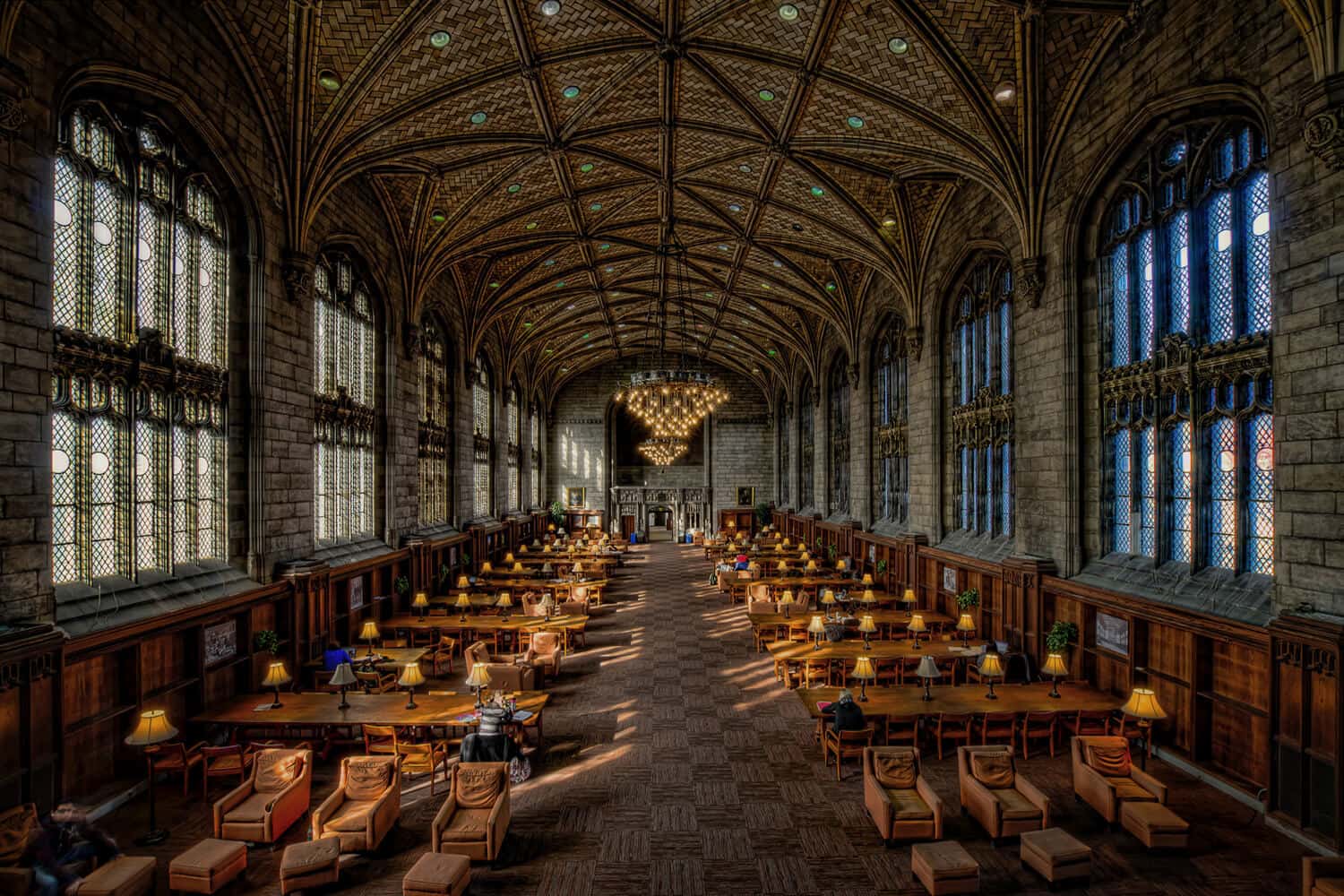
Walk into the Reynolds Club or wander through the neo-Gothic quadrangles on a Tuesday afternoon, and you’ll hear it. Students aren't just talking about "their dorm." They’re talking about "their house." It’s a distinction that sounds subtle, maybe even a bit pretentious to an outsider, but it’s the bedrock of the entire undergraduate experience. The University of Chicago houses aren't just places where you sleep between grueling shifts at Regenstein Library; they are self-governed, slightly chaotic, deeply loyal micro-communities that define your social life for four years.
Honestly, the whole thing feels a little like Harry Potter, but with less magic and significantly more caffeine.
Every single student who enters the College is sorted—not by a hat, but by a housing portal—into one of 48 houses. These houses are tucked away inside seven different residence halls. You might end up in the sleek, glass-heavy architecture of Campus North, or you might find yourself in the wood-paneled, drafty charm of Burton-Judson Courts. But regardless of the physical walls, the "house" is the people. It’s the Resident Masters (now often called Resident Deans) who host multi-course dinners in their apartments. It's the Resident Heads who live on your floor with their kids and dogs, acting as the cool older siblings you never had.
The House Table and the Cult of Loyalty
If you want to understand University of Chicago houses, you have to look at the dining halls. Each house has its own designated table. It’s unwritten law. You don't just sit anywhere; you sit with your house. This is where the "Life of the Mind" actually happens. It’s where a physics major and a medieval history buff argue about the ethical implications of AI over lukewarm tater tots.
It’s intense.
Some people find this stifling. Others find it’s the only thing keeping them sane when the Chicago winter hits in February and the wind-chill off Lake Michigan makes walking to class feel like an Arctic expedition. The loyalty is real. You’ll see students wearing house-specific scarves or t-shirts with obscure inside jokes that no one else on campus understands. It’s a way of making a massive, world-class research university feel like a small liberal arts college.
Where You Live Matters: Breaking Down the Residence Halls
Where you actually end up living can change your entire vibe. The University of Chicago houses are distributed across buildings that range from "ultra-modern skyscraper" to "castle from the 1920s."
Campus North Residential Commons is the big one. Designed by Studio Gang (the same firm that did the Aqua Tower), it’s hard to miss with its white pre-cast concrete panels and jagged windows. It’s home to houses like Yovovich and Behar. It’s airy. It’s bright. It’s also right next to Ratner Athletics Center, which is great if you actually work out. But some purists argue it lacks the "old school" UChicago grit.
Then you have Burton-Judson (BJ). If you want the dark academia aesthetic, this is it. It’s got the courtyards, the ivy, and the feeling that a ghost might be haunting the communal showers. Houses here, like Linn-Mathews or Salisbury, tend to have very long-standing, slightly eccentric traditions. It’s farther from the main quad, which means you’re basically on an island, but that just makes the house bonds tighter.
Max Palevsky (Max P) is the colorful one. Literally. It was designed by Ricardo Legorreta and is famously bright orange and pink. It’s smack in the middle of campus. If you live in Alper or Hoover, you can roll out of bed five minutes before a lecture and probably make it. It’s the "social" hub, mostly because its location makes it impossible to ignore.
The Tradition of Scav and House Spirit
You can’t talk about University of Chicago houses without talking about Scav. The University of Chicago Scavenger Hunt is the largest in the world. It’s a four-day fever dream of building nuclear reactors (yes, that happened) and driving to Canada for a specific type of soda.
Houses are the primary units for Scav.
The basement of a house becomes a war room. People stop sleeping. They start welding. They start sewing. They start coding. It’s a massive logistical undertaking that proves UChicago students are capable of incredible things when they aren't worried about their GPA. The house system provides the infrastructure for this madness. Without the houses, Scav would just be a bunch of lonely nerds looking for weird items; with the houses, it’s a coordinated tactical operation.
The Secret Sauce: Resident Deans and RHs
The "adults" in the house system are what make it function. These aren't just security guards or administrators. Resident Deans are usually high-ranking faculty members. Imagine having a world-renowned economist or a leading sociologist living in your building and inviting you over for Sunday Night Tea. It breaks down the barrier between student and professor in a way that’s pretty rare at elite universities.
Then you have the Resident Heads (RHs). They are usually grad students or young professionals. They live in the house. They organize "Munchies"—which is exactly what it sounds like. Every week, the house gathers for free food. It might be Popeyes, it might be homemade crepes, or it might just be a mountain of Oreos. It’s the one time a week everyone comes out of their rooms.
It’s honestly a bit surreal to see a toddler running through a dorm hallway while students are debating Nietzsche in the background, but that’s just life in UChicago housing.
The Myth of the "Anti-Social" Student
There’s a stereotype that UChicago is "where fun goes to die." People think the houses are just quiet cells where students study until they collapse.
That’s mostly wrong.
The fun just looks different. It’s not always a rager with a keg. Sometimes it’s a house trip to see the Chicago Symphony Orchestra, or a "House Trip" to a local bowling alley, or a midnight ice skating session at Midway Plaisance. The University of Chicago houses actually subsidize these things. They have budgets. They want you to get out of the library.
Is it "party hard" culture? Not really. It’s more "intense hobby" culture. You’ll find a house that is weirdly obsessed with board games, and another that is basically a semi-professional intramural broomball team. You find your niche.
Choosing a House: Can You Actually Pick?
Here’s the thing: you don’t really pick your house. You pick your building preferences. You rank them. The university tries to match you, but there’s a lot of luck involved.
A lot of incoming freshmen stress about this. They think if they don’t get into Woodlawn or North, their social life is over. That’s not how it works. Because the house culture is so internal, you end up loving wherever you land. You’ll find yourself defending the merits of International House (I-House) even though it’s a bit of a hike from the center of campus, simply because your housemates are the best people you’ve ever met.
- Woodlawn Residential Commons: The newest kid on the block. Huge. Modern. It feels a bit like a hotel, but the views of the South Side and the lake are incredible.
- I-House: It has a global focus. Lots of international students and grad students. It’s elegant and has a very different, more mature energy.
- Snell-Hitchcock: This is the legendary one. It’s the smallest and oldest. It’s where the "classic" UChicago culture is most concentrated. If you like traditions that date back 100 years, this is your spot.
The Transition to Off-Campus Life
Usually, students stay in the houses for their first two years. Some stay all four. If you move off-campus into an apartment in Hyde Park, you still technically belong to your house. You can still show up for Munchies. You can still participate in Scav.
But the "gravitational pull" of the house definitely weakens once you’re responsible for your own groceries and rent. Most people find that the friends they made in their house during freshman year are the ones they end up living with in an apartment on 55th Street later on.
Actionable Steps for Future Maroons
If you’re a prospective student or a confused freshman, don't overthink the housing application. You aren't choosing a destiny; you’re just choosing a starting point.
1. Focus on the vibe, not the floor plan. Do you want a big, bustling community (North/Woodlawn) or something intimate and potentially creaky (Snell-Hitchcock/BJ)? That’s the real choice.
2. Go to Munchies. Even if you’re tired. Even if you have a p-set due. This is where the social glue is manufactured. If you skip house events, the house system just becomes a hallway with your bed in it.
3. Talk to your Resident Heads. They are an incredible resource for navigating the stress of UChicago. They’ve seen it all before—the breakdowns, the triumphs, the mid-quarter crises. Use their expertise.
4. Respect the House Table. It’s okay to eat with friends from class, but make an effort to sit at your house table at least once a day. It’s the easiest way to stay plugged in without needing to "schedule" social time.
5. Participate in Scav. Even if you just do one tiny task. It’s a rite of passage. You haven't truly experienced a University of Chicago house until you’ve helped build a 15-foot sculpture out of recycled cardboard at 3:00 AM.
The house system is what you make of it. It’s a safety net in a high-pressure environment. It’s a place where "weird" is the norm and where everyone is a little bit obsessed with something. Whether you’re in the ultra-modern towers of Woodlawn or the Gothic halls of BJ, the house is your home base. Don't waste it.